
EN 17353
ENHANCED VISIBILITY protective clothing
EN 17353 specifies requirements for protective clothing intended to improve the wearer’s visibility in situations of medium risk. The standard covers garments designed to ensure increased visibility in daylight (Type A), in darkness when illuminated by vehicle headlights or searchlights (Type B), or in both daylight and darkness conditions (Type AB).
Read our guide 8 STEPS TO THE RIGHT PROTECTIVE CLOTHING


WHAT DOES THE STANDARD EN 17353 MEAN?
EN 17353 is a high-visibility standard that specifies requirements for garments intended to improve the wearer’s visibility in situations where high visibility in accordance with EN ISO 20471 is not required, but where there is still a need to increase the wearer’s visibility.
The standard is intended for environments with medium risk, for example more controlled areas with traffic moving at lower speeds where the wearer keeps watch over the traffic.
CLASSIFICATION
The garments are divided into different types, depending on the conditions under which they are to provide increased visibility:
| Symbol | Type | Visibility in | Material requirements |
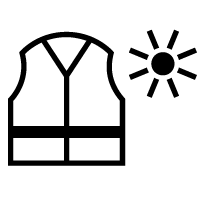 |
A | Daylight | Fluorescent material |
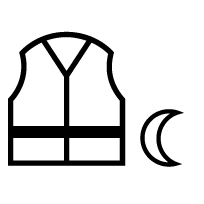 |
B2 | Darkness* | Retroreflective material around the arms or legs |
|
B3 |
Darkness* |
Retroreflective material around the torso and around the arms or legs if the garment covers these |
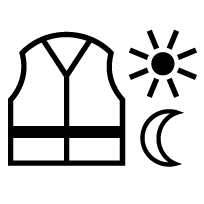 |
AB2 | Daylight and darkness* | Fluorescent and retroreflective material around the arms or legs |
|
AB3 | Daylight and darkness* | Fluorescent and retroreflective material around the torso and around the arms or legs if the garment covers these |
*When the wearer is illuminated by vehicle headlights or searchlights.
MATERIAL SURFACE REQUIREMENTS
As with EN ISO 20471, EN 17353 sets requirements for the minimum permitted area of fluorescent and/or retroreflective material on the garment. The requirements are designed to ensure that the garment provides sufficiently high contrast and visibility against the surroundings, depending on the type of visibility and intended use situation for the garment.
Minimum material surface requirements (m²) for people taller than 140 cm:
| Type A | Type B2 | Type B3 | Type AB2 | Type AB3 | |
| Fluorescent | 0,240 | - | - | 0,240 | 0,240 |
| Reflective | - | 0,018 | 0,080 | 0,018 | 0,080 |
Minimum material surface requirements (m²) for people who are 140 cm or shorter:
| Type A | Type B2 | Type B3 | Type AB2 | Type AB3 | |
| Fluorescent | 0,140 | - | - | 0,140 | 0,140 |
| Reflective | - | 0,018 | 0,060 | 0,018 | 0,060 |
EN 17353 vs EN ISO 20471
Unlike EN ISO 20471, which is mandatory for high visibility in high-risk work environments (for example roadworks), EN 17353 is intended for medium-risk environments. The choice between these standards is determined by factors such as vehicle speed, traffic density, weather conditions, background contrast and the type of road user involved.
A passive road user (a person on the road who is not taking part in vehicle traffic and whose attention is directed towards something other than traffic) and higher vehicle speeds generally require EN ISO 20471, while an active road user (a person on the road who is taking part in traffic and whose attention is directed towards traffic) in controlled low-speed environments is often sufficiently protected by EN 17353. A thorough risk assessment should determine which standard is appropriate in each individual case.
Our approach ensures that all garments marketed as “visible” meet the correct certification – either EN ISO 20471 for high-risk environments or EN 17353 for medium risk. In this way, our customers can feel confident that they are wearing the right level of protection for their work – no more and no less.

PRODUCTS WITH EN 17353

Browse our high-visibility products.
EN 17353 Type A

Browse our high-visibility products.
EN 17353 Type B2

Browse our high-visibility products.
EN 17353 Type AB2

WOULD YOU LIKE TO LEARN MORE ABOUT STANDARDS?
Sign-up for Tranemo Safety Academy or get in touch with an expert.