How to reduce the risk of serious hand injuries

Hand injuries can have serious consequences. Read how risk analysis, the right protective gloves and working methods can reduce injuries in high‑risk environments.
Besides the face, the hands are probably one of the body parts that we humans value the most. Yet during my time in the protective equipment industry, I have come across countless reports and stories about severe burns to the hands. Injuries that in most cases could have been avoided if the affected person had had the right knowledge and used the right protective gloves.
In this article, I highlight how exposed the hands are when working in environments with a risk of heat, flames and arc flash, and explain how this important body part can be protected in the best possible way. The purpose is to increase risk awareness and reduce the number of serious injuries to the hands.
The closer the danger, the greater the risk
When working in an electrical installation, such as switchgear, transformers and track-bound areas, there may be a risk of arc flash and electric shock. Because the hands are usually closest to the potential danger, they are also the most exposed if an accident should occur. The thermal arc flash energy decreases exponentially with distance, that is, the closer to the danger, the greater the risk, and vice versa. See image below.
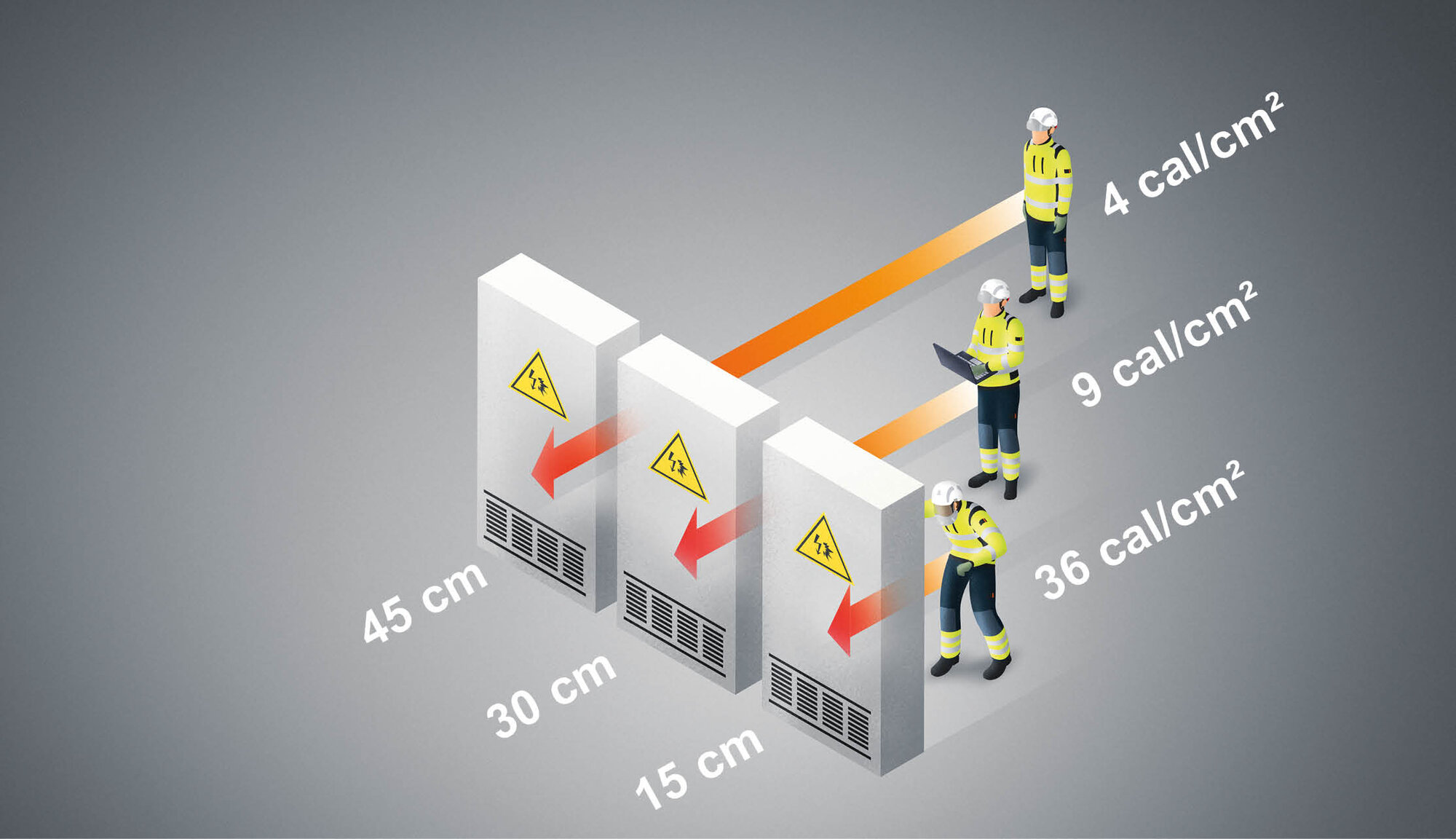
When an arc flash is triggered, massive thermal radiation can be created. Temperatures above 10,000 °C are not uncommon, which entails a high risk of serious burns. However, the energy and heat decrease exponentially with distance.
The hands, which are often closest to the potential danger, can therefore, if a strong arc flash is triggered, be exposed to very high energy levels and extreme heat. In the image above, it is illustrated how the thermal arc flash energy was measured at 9 cal/cm² at a distance of 30 cm. The energy increases by a factor of four to 36 cal/cm² when the distance is reduced to 15 cm, where the hands are often located. It is good to know that the skin is damaged already at exposure to an energy as low as 1.2 cal/cm², which corresponds to holding your finger above a burning candle for one second.
What level of protection should the gloves have?
At least the same level of protection as your certified protective clothing. However, to ensure sufficient protection, we recommend that you use protective gloves with a higher protection level than your other protective garments. It is important to remember that the hands are closer to the danger than other parts of the body, which is why it is crucial to choose protective equipment that provides maximum safety.
If you work in an environment with an arc flash risk, you should always use gloves with arc flash protection. If there is also a risk of electric shock, for example when working on live systems, you should use insulating protective gloves made of, for example, natural latex. For extra protection in this type of environment, we also recommend that you wear an over-glove made of leather on top of the insulating gloves, since leather has an inherent protection against heat and flames.
One of my most important pieces of advice is that you should never use nylon gloves when working in an electrical installation. Unfortunately, there are several examples of arc flash accidents where the affected person was wearing nylon gloves, with the result that the nylon melted into the skin and caused third-degree burns.
Things to consider when using protective gloves
- Use gloves with a higher level of protection than your other protective clothing
- Make sure that your protective clothing overlaps the gloves at the wrists
- Use dry gloves – damp or wet gloves can create steam that significantly reduces the level of protection
- Use clean gloves – even if the gloves are flame-resistant, oil and dirt on the gloves can ignite and cause burns
- Bring an extra pair of protective gloves in case one pair becomes wet or dirty during the workday
- Use the right size – well-fitting gloves reduce the risk of mistakes